










0. Introduction
With the advancement of technology, smart homes have gradually become prevalent in many households. The various control methods and home automation features of smart homes have attracted numerous consumers. The product range of smart homes is quite extensive, ranging from large appliances like refrigerators, televisions, and solar heating systems to small devices like NFC tags and remote control buttons. Today, we will focus on one of the most common smart home devices – smart wall switches.
Before diving into smart wall switches, let’s first understand the two main categories of traditional wall switches. This knowledge will influence your selection of smart wall switches and prevent unnecessary losses caused by purchasing mistakes.
One of the categories is the “Neutral Wire Switch,” which requires a neutral wire for proper functioning. The other category is the “No Neutral Wire Required Switch” or “Single Live Wire Switch,” which, as the name suggests, does not need a neutral wire for installation and operation.
1. Understanding Single Live Wire Switch and Neutral Wire Switch
Common Issues with Traditional Wall Switches
Before the advent of “Smart Wall Switches,” there were no specific terms like “Neutral Wire Wall Switch” or “Single Wire Wall Switch.” The only distinction lies in how the “switch” is connected either to the live wire (fire wire) or the neutral wire. This connection determines the control of turning the light bulb on and off.
When the switch is connected to the neutral wire, it functions properly. However, due to the live wire carrying electricity and the neutral wire being non-electrified, when the switch is installed with the neutral wire, the light bulb will be directly connected to the live wire. This means that the light bulb remains electrified, regardless of whether it is turned on or off. When a person touches the glass part of the light bulb, there is no electrical conductivity, and it will not cause any harm. However, if a person touches the metal part of the bulb, an electric shock can occur. Refer to Figure 1 below for illustration.
(Comparison Between Connecting Switch to Neutral Wire and Live Wire)

Therefore, installing the “switch” on the neutral wire is very unsafe and non-standard.
As a result, the commonly seen “wall switch” in our homes must be connected to the live wire.
The most straightforward difference between the traditional No Neutral Required Switch (Single Wire Switch) and the Neutral Wire Switch lies in their wiring configurations.
As shown in the diagram:
The No Neutral Required Switch (Single Wire Switch) only has the live wire connected to the control line of the light.
On the other hand, the Neutral Wire Switch has both the live wire and the neutral wire connected to the control line of the light.
 Utilize the sunrise or sunset time in your city as triggers. Additionally, you can set the trigger to occur at specific minutes before or after sunrise/sunset. Up to 30 minutes can be set.
2. Smart Wall Switches
The regular “wall switch” operates manually, allowing users to turn the light on or off by physically interacting with the switch. However, the reason why “smart switches” are considered intelligent is due to the integration of a “smart control module” within the switch. Once the switch is turned off, both the “light bulb” and the “remote control module” lose power simultaneously, resulting in the “smart control module” being unable to perform remote control functions.
To make a “switch” smart, it is essential to ensure an uninterrupted power supply to the “smart control module.” There are two methods to achieve this: the “Smart Neutral Wire Wall Switch” and the “Smart No Neutral Required Wall Switch.” Both of these methods ensure that the “smart control module” remains powered and functional for smart control capabilities.
The Principle of Smart Neutral Wire Wall Switch
In the Smart Neutral Wire Wall Switch, the live wire and the neutral wire are connected to the “Smart Control Module” on the smart wall switch, providing power supply as shown in the following diagram.

When the smart wall switch is in the OFF position, the “Smart Control Module” continues to receive power supply from the neutral wire (A) and live wire (B). However, since the light is not connected to the power supply, it remains off.
Conversely, when the smart wall switch is in the ON position, both the “Smart Control Module” and the light bulb receive power supply, causing the light to turn on.
Therefore, the Smart No Neutral Wall Switch ensures that the “Smart Control Module” remains powered, whether the light bulb is on or off. This allows the switch to maintain a continuous connection to the network, enabling control through various means like voice commands from a mobile phone.
The Principle of Smart No Neutral Wire Required Wall Switch
Inside the Smart No Neutral Wire Required Wall Switch, there is a built-in variable resistor used to control the current. This method is employed to supply power to the “Smart Control Module.” The wiring diagram for the Single Wire version of the switch is shown below:

The “Smart No Neutral Wire Required Wall Switch” integrates a variable resistor in series with the light bulb. When the light bulb needs to be turned off, the variable resistor is adjusted to a high value, almost approaching an open circuit, but not entirely. There is still a tiny current flowing through the circuit, providing power to the “Smart Control Module.”
Due to the use of the variable resistor, the Smart No Neutral Wall Switch often has the following drawbacks:
- If the quality of the light bulb is poor, it may cause flickering after turning off the light.
- Power limitation – Most No Neutral Wire Required version smart wall switches can only handle devices up to 800 watts, whereas the Neutral Wire version can typically support devices up to 2500 watts.
- Higher cost – Due to different design requirements, the production cost of the Smart No Neutral Wall Switch is generally higher compared to the Neutral Wire version.
3. Common Smart Wall Switch Types
Smart wall switches can be classified into various types based on channel count, size, and functionality. The most common types are 1-gang, 2-gang, and 3-gang switches. The “gang” number refers to the number of circuits a switch can control independently. Additionally, they can be either 80mm or 86mm in size, which corresponds to the standard wall box dimensions.
Some smart switches are designed to integrate seamlessly with platforms like Matter, allowing cross-platform control via apps or voice assistants.
4. Choosing Between Neutral and No Neutral Switch
When selecting a smart switch, the wiring in your home is the first consideration. If your wall has a neutral wire, you have more flexibility in choosing a smart switch and can install higher-power devices. If your wall does not have a neutral wire, you should opt for a No Neutral Required switch, keeping in mind the limitations on load power and potential flickering issues with certain bulbs.
In summary:
- Neutral Wire Smart Switch: Supports higher power, stable performance, lower cost.
- No Neutral Wire Smart Switch: Can be installed where no neutral wire exists, may cause flicker, higher cost, limited power.
5. Summary
Smart wall switches are an essential component of modern smart homes. Understanding the difference between neutral wire and no neutral wire switches is critical to making the right choice. Selecting the appropriate switch ensures safety, stability, and compatibility with your home’s electrical wiring.
For the best user experience, consider:
- Check if a neutral wire is available in the wall box.
- Choose a switch with Matter support for cross-platform integration.
- Consider the number of gangs based on the number of circuits you want to control.
- Check the power load requirements for your lighting and appliances.
6. SONOFF Wall Switches Recommendation
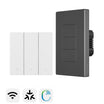
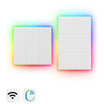
| Product | ZBM5 Zigbee Smart Wall Switch | M5 Matter | TX Ultimate |
|---|---|---|---|
| Product introduction | Discover the ZBM5 Zigbee Smart Wall Switch, available in 1–3 gang and 80/86 and 120 types. Designed with a no-neutral option for easy retrofit, it supports Zigbee for stable control, app and voice control, plus smart scenes and scheduling for a seamless smart home experience. | SONOFF M5 Matter Smart Wall Switch is a mechanical smart neutral wire switch available in 1/2/3 gang, supporting local button, app, and voice control. Powered by Matter, it enables fast, reliable control and seamless cross-platform smart home integration. | Upgrade to the TX Ultimate smart neutral wire touch wall Switch! Enjoy full touch access, smart LED light, and replaceable switch covers for a colorful life experience. |
| Price | $/€17.9 – $29.9 | $/€17.9 – $/€19.59 | $/€24.90 – $29.90 |
| Switch Standard | 80/86/120 | 80/86/120 | 86/120 |
| Gang | 1 Gang/2 Gang/3 Gang | 1 Gang/2 Gang/3 Gang | 1 Gang/2 Gang/3 Gang |
| Product Color | White | Dim Gray/White | White |
| Protocol | Zigbee | Matter Over WiFi | WiFi |
| Operating Mode | Touchscreen control | Physical button to operate | Touchscreen control |

Leave a comment
All comments are moderated before being published.
This site is protected by hCaptcha and the hCaptcha Privacy Policy and Terms of Service apply.