










Introduction
High-power appliances such as electric water heaters, heat pumps, underfloor heating systems, EV chargers, and kitchen appliances like ovens, induction cooktops, and electric dryers are becoming increasingly common in modern homes.
Unlike lighting, small appliances, and medium-power devices, these appliances often operate on dedicated circuits under heavy electrical loads for extended periods. For applications like these, DIN rail switches are commonly used because they are designed to integrate directly into electrical panels and provide a more reliable control solution for fixed high-power circuits.
However, not all DIN rail switches are designed for demanding high-power applications. Choosing the right DIN rail switch for high-current loads is not only about selecting a device with a suitable rating, but also understanding whether it can deliver safe and reliable operation over the long term.
In this guide, we'll explain how smart DIN rail switches work, the key factors that determine reliable high-load control, and how SONOFF DIN rail switches — BASIC-1GSP and BASIC-ZB1GSP are designed for demanding high-power applications.
What Is a DIN Rail Switch?
A smart DIN rail switch is an electrical device designed to remotely control circuits and connected loads inside an electrical panel (also called a distribution board). It uses an internal relay to control power to connected circuits and can provide functions such as remote switching, energy monitoring, scheduled control, and automation.
Unlike plug-in smart plugs or wall switches, it is mounted directly onto a standard DIN rail and integrated into the electrical wiring system.
A DIN rail is a standardized metal mounting rail widely used in electrical distribution boards. It provides a secure and organized way to install electrical components such as circuit breakers, relays, and smart control modules.
Once installed, it can remotely switch the circuit and provide smart features such as real-time energy monitoring, scheduled control, and automation.
👉Note: DIN rail switches are designed with different current ratings and features for different applications. The selected model should match the electrical requirements of the connected load.
What Makes a DIN Rail Switch Reliable for High-Current Loads?
A high current rating alone does not guarantee reliable long-term performance. For devices controlling high-power loads, factors such as load compatibility, thermal management, relay durability, and electrical safety all affect reliability over time.
Designed for High-Load Operation
DIN rail switches used for high-power applications need to handle continuous electrical loads, not only short-term current peaks. Different appliances can create different electrical stresses depending on their load characteristics and operating patterns.
Important factors include:
- Rated current capacity for the connected load
- Compatibility with resistive, inductive, and capacitive loads
- Ability to handle temporary inrush current from devices such as motors, pumps, or compressors
Effective Heat Management During Continuous Operation
When High-current flows through electrical components, resistance generates heat. During long periods of operation, excessive temperature rise can accelerate component aging and affect reliability.
A reliable design should minimize unnecessary heat generation and maintain stable temperatures during continuous operation.
Important factors include:
- Low-resistance current paths to reduce power loss and heat buildup
- Proper internal layout and heat dissipation design
- Materials and construction suitable for long-term high-load operation
Durable Relay Design for Repeated Switching
The relay is the core switching component inside a DIN rail switch. Every switching action creates electrical stress on the contacts, and repeated arcing can gradually reduce contact performance, especially with high-current or inductive loads.
- High electrical endurance under load conditions
- Better resistance to arcing and contact wear
- Stable switching performance after repeated operation
Electrical Safety During High-Load Operation
Since DIN rail switches are installed inside electrical panels and connected to mains circuits, safety design is essential for reliable operation.
Key factors to look for:
- Proper insulation and electrical isolation
- Double-pole switching for improved circuit isolation
- Flame-retardant housing materials
- Compatibility with upstream protection devices such as MCBs
SONOFF BASIC DIN Rail Smart Switches for High-Power Loads
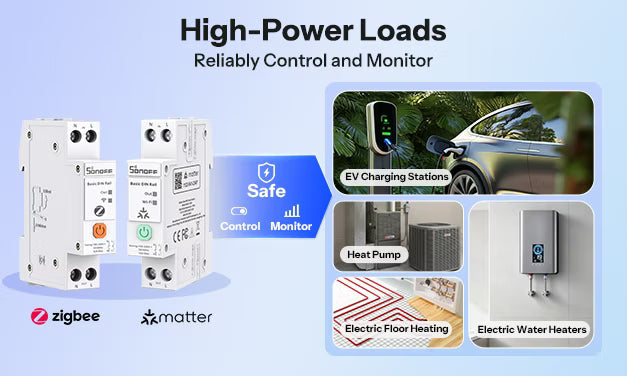
SONOFF Basic DIN Rail is a series of single-channel DIN rail-mounted smart relay switches designed for controlling connected high-power appliances and electrical circuits. The series includes BASIC-1GSP (Matter over Wi-Fi ) and BASIC-ZB1GSP (Zigbee), offering different connectivity options for smart home setups.
Supporting loads up to 32A, they are suitable for high-power applications such as water heaters, heat pumps, electric boilers, underfloor heating systems, EV charger circuits (where compatible with installation requirements), and other high-power appliances that require reliable switching control.

SONOFF Basic DIN Rail Matter Over WiFi Smart Switch | BASIC-1GSP
$19.90
Matter over Wi-Fi DIN rail smart switch rated up to 32A, with built-in energy monitoring, electricity bill tracking, double-pole switching, and seamless integration with major smart home platforms, including Apple Home, Google Home, Amazon Alexa, and Samsung SmartThings.
View Product
SONOFF Basic DIN Rail Zigbee Smart Switch | BASIC-ZB1GSP
$19.90
32A Zigbee DIN rail smart relay with energy monitoring, double-pole switching, and functions as a Zigbee router capability to strengthen your Zigbee network.
View ProductIn addition to remote switching, Basic DIN Rail provides real-time energy monitoring, overload protection, and smart automation, allowing users to track energy consumption, manage connected devices remotely, and optimize energy usage through the eWeLink App and compatible smart home platforms.

SONOFF BASIC DIN Rail: Key Design Features for Reliable High-Power Operation and Safety
Designed for high-power circuit control, SONOFF Basic DIN Rail smart relay switches incorporate multiple hardware features to support stable operation under continuous loads, frequent switching, and demanding electrical conditions. These designs focus on current handling, heat management, relay durability, and electrical safety.
1. High-Current Design for Stable Operation
Pure copper busbar structure:
- Uses an integrated solid copper current path with fewer solder joints, reducing resistance and minimizing heat generation during high-current operation.
- Under full-load testing at 50°C ambient temperature, the temperature rise remains below 25K, helping maintain stable operation during continuous high-current loads.
63A relay margin design:
- Provides additional relay capacity margin beyond the rated operating current, helping reduce electrical stress during long-term operation.

2. Double-Contact Switching Design for Longer Switching Life
- Uses a dual-contact design to help distribute electrical stress and reduce wear caused by capacitive loads, improving relay durability and supporting more switching cycles.
- The relay supports over 10,000 full-load switching cycles, providing longer service life for frequently switched circuits.
3. Magnetic Latching Relay for Lower Energy Loss
- Uses a magnetic latching relay that only consumes power during switching instead of continuously energizing the coil.
- With up to 5W pulse drive power and over twice the switching speed compared with similar relay switches, it enables faster relay actuation while reducing unnecessary heat generation during long-term operation.
4. Electrical Safety Features for High-Power Circuits
Double-pole switching for improved isolation:
- Disconnects both live and neutral conductors simultaneously, providing more complete electrical isolation compared with single-pole switching.
- This design is suitable for fixed high-power circuits where complete circuit disconnection is preferred during maintenance or shutdown.

UL94 V-0 flame-retardant housing:
- Uses UL94 V-0 rated flame-retardant material. During UL94 V-0 testing, the material self-extinguishes within 10 seconds after flame exposure and produces no flaming drips, providing additional protection for electrical panel installations.

Overload protection:
- Provides additional protection against abnormal current conditions. (Note: It is not a replacement for required upstream protection devices such as MCBs or RCBOs.)

How to Install a DIN Rail Switch?
Installing a DIN rail switch requires working inside the electrical panel, so proper electrical knowledge and safety awareness are important. The device is mounted onto a standard DIN rail and connected to the electrical circuit it is designed to control.
In a typical installation, the DIN rail switch is installed downstream of the appropriate circuit protection devices and should not be connected directly to the incoming power supply.
Typical installation layout:
- Grid / Utility Supply → Utility Meter → Circuit Protection (RCD/RCCB/RCBO + MCB) → DIN Rail Switch → Electrical Load

Key installation considerations:
- Install the device inside a compatible electrical distribution box with a standard DIN rail.
- Ensure the connected load matches the switch's rated capacity and electrical requirements.
- Use appropriate upstream circuit protection devices, such as an MCB or RCBO, according to local electrical regulations.
⚠ Installation Safety Note:
- DIN rail switches are installed inside electrical panels and work with mains voltage. Always disconnect power before installation, wiring, or maintenance. Never touch terminal connections while the device is energized.
- If you are not familiar with electrical work or local installation requirements, consult a qualified electrician.
👇For SONOFF Basic DIN Rail Switch installation, refer to the following video for a detailed installation overview.
Practical Applications of a DIN Rail Switch for High-Current Loads
Once installed in the electrical panel, a smart DIN rail switch allows you to remotely control connected circuits, create automation schedules, and integrate high-power appliances into smart home or building management systems. Some models also support energy monitoring features, enabling you to track electricity usage and better understand the operating patterns of connected devices.
Below are some common applications of DIN rail switches for high-power load control.
Smart Heating Control for Comfortable Living and Working Spaces
Heating systems such as underfloor heating, heat pumps, electric boilers, and electric heaters often operate for long periods during colder seasons. A DIN rail switch allows you to integrate these high-power heating circuits into smart home or building automation systems, making it easier to manage heating schedules and improve daily comfort.
Whether it is your living room, a yoga studio, gym changing room, spa center, or small office, you can create heating schedules based on occupancy and daily routines.
Example applications:
● Preheat rooms before arrival.
● Maintain comfortable temperatures during business hours.
● Create heating scenes for different daily routines.
● Automatically control heating based on schedules.
Smart Water Heater Control and Scheduling
Electric water heaters are common high-power appliances in many homes and are often connected to dedicated electrical circuits. A DIN rail switch provides a convenient way to remotely control water heating systems and create schedules based on household routines.
Instead of keeping water heaters running continuously, you can automate operation based on actual hot water needs, helping improve convenience and avoid unnecessary operation.
Example applications:
● Schedule water heating based on household routines.
● Turn off the water heater automatically after a defined operating period.
● Control hot water systems remotely when away from home.
● Review energy usage trends with models that support power measurement.
High-Power Kitchen and Appliance Circuit Control
Modern kitchens and utility areas often include high-power appliances such as electric ovens, induction cooktops, dishwashers, and dryers. These appliances are typically connected to dedicated electrical circuits and may require reliable switching control for daily operation.
A DIN rail switch allows you to manage fixed appliance circuits remotely, create automation schedules, and integrate high-power appliances into smart home systems.
Example applications:
● Manage selected appliance circuits remotely.
● Create automatic shutdown schedules for selected circuits.
● Integrate appliances into smart home routines.
● Review electricity usage with models that support energy measurement.
Smart EV Charging Management
EV chargers typically operate on dedicated circuits and may consume significant power during charging sessions. A DIN rail switch can provide smart control over the charging circuit, allowing users to manage when charging is available and integrate EV charging into smart home routines.
Example applications:
● Schedule charging based on preferred time periods.
● Enable or disable charging remotely.
● Integrate EV charging with smart home automation.
● View charging usage data with supported models.
Smart Control for Commercial and Building Applications
Beyond residential use, DIN rail switches are also suitable for commercial and building environments where multiple fixed electrical circuits require reliable control and automation.
DIN rail switches can help businesses, property managers, and facility operators manage heating systems, equipment, and other electrical loads more efficiently.
Applications include:
● Apartments and hotels
● Offices and retail stores
● Restaurants and gyms
● Universities and public facilities
Example applications:
● Schedule equipment operation based on business hours.
● Control heating and electrical equipment remotely.
● Manage circuits across different areas.
● Integrate electrical systems into building automation platforms.
Conclusion
As homes adopt more high-power devices such as heat pumps, water heaters, EV chargers, and electric heating systems, reliable control becomes just as important as smart control. Unlike ordinary smart plugs, DIN rail switches used for high-current applications need to be designed with proper load handling, thermal management, relay durability, and electrical safety features to ensure reliable long-term operation.
SONOFF BASIC-1GSP and BASIC-ZB1GSP are designed for these demanding applications, combining 32A high-power load support, reliable hardware design, real-time energy monitoring, and smart control. Available in Matter over Wi-Fi and Zigbee versions, they provide flexible options for different smart home setups.
Whether you want to manage operating schedules, understand energy usage, or more reliable smart control to your electrical system, a properly designed DIN rail switch provides a reliable solution.
FAQ
Q1: What is a DIN rail switch used for?
A DIN rail switch is used to remotely control fixed electrical circuits and connected loads installed inside an electrical panel. Unlike plug-in smart plugs, it is mounted directly onto a standard DIN rail and provides a more permanent and integrated solution for controlling high-power electrical applications.
Common applications include electric water heaters, heating systems, underfloor heating, heat pumps, EV charging circuits, pumps, and other fixed electrical loads that require reliable switching, scheduling, or smart automation.
Q2: Where is a DIN rail switch installed?
A DIN rail switch is installed inside an electrical distribution box or electrical panel on a standard DIN rail. It is typically connected together with appropriate circuit protection devices, such as MCBs or RCBOs, according to the electrical system and local installation requirements.
Installation requirements may vary depending on the product, electrical system, and regional regulations.
Q3: Can a DIN rail switch control high-power appliances?
Yes, a properly rated DIN rail switch can be used to control high-power appliances and electrical circuits. However, the switch must match the electrical requirements of the connected load.
Common applications include water heaters, heat pumps, electric boilers, underfloor heating systems, and EV charger circuits. Factors such as rated current, load type, startup current, installation method, and local electrical requirements should be considered.
Q4: Does a DIN rail switch replace a circuit breaker?
No. A DIN rail switch does not replace a circuit breaker or other protective devices.
A circuit breaker (MCB) is designed to protect electrical circuits from conditions such as overloads and short circuits. A DIN rail switch is mainly designed for switching control, smart automation, and in some cases energy monitoring.
They serve different purposes and work together as part of a complete electrical installation.
Q5: What is the difference between a smart plug and a DIN rail switch?
A smart plug is designed for portable appliances and lower-power devices, such as lamps, small appliances, and consumer electronics. It can usually be installed without modifying the electrical wiring.
A DIN rail switch is installed inside an electrical panel and is designed for controlling fixed circuits or higher-power loads. It provides a more integrated solution for applications where a plug-in device is not suitable, such as water heaters, heating systems, or dedicated appliance circuits.
Q6: What appliances can be controlled with a DIN rail switch?
A DIN rail switch can be used to control various fixed electrical loads that require reliable switching and automation.
Common applications include:
● Electric water heaters
● Heat pumps
● Underfloor heating systems
● Electric boilers
● EV charging circuits
● High-power kitchen appliances
● Pumps and other fixed electrical equipment
The suitability of each application depends on the electrical characteristics of the connected load and the switch specifications.
Q7: Can a DIN rail switch monitor energy consumption?
Some smart DIN rail switches include built-in energy monitoring features that allow users to view power consumption and energy usage data over time.
This information can help users better understand the operating patterns of connected appliances and make smarter decisions about device operation.
Energy monitoring capabilities depend on the specific model and installation requirements.
Q: Does energy monitoring require a neutral wire?
For many smart DIN rail switches with built-in energy monitoring, a neutral wire connection is required to enable accurate power measurement.
Always follow the wiring requirements provided by the manufacturer, as requirements may vary between devices.
For example, SONOFF BASIC-ZB1GSP and BASIC-1GSP require a neutral wire connection to enable energy monitoring functions.

Leave a comment
All comments are moderated before being published.
This site is protected by hCaptcha and the hCaptcha Privacy Policy and Terms of Service apply.