



Introduction
Setting a temperature on your central heating thermostat is simple. Getting comfortable temperatures throughout your home isn't always as straightforward. Some rooms may feel too warm or too cold, and your heating may not run when you need it.
A thermostat controls heating based on the temperature it measures, but its location, settings, and the way heat moves through your home all affect the result.
This guide explains how central heating thermostats work, where to place them, how to set temperatures and heating schedules, and when TRVs or smart heating controls can help.
How Does a Central Heating Thermostat Work?
A central heating system provides heat to multiple rooms from a central source, rather than using separate heaters in each room. Depending on the system, heat may come from a boiler, heat pump, furnace, or district heating network.
- In many European homes, hot water circulates through pipes to radiators or hydronic underfloor heating, then returns to the heat source after releasing heat.
- Other systems, such as forced-air heating commonly used in North America, distribute warm air through ducts and vents.
A room thermostat measures the temperature in the area it monitors and compares it with the target temperature. Based on its control settings, it sends a heating demand to the connected heating system when more heat is needed and ends that demand when the room is sufficiently warm.
- For example, a hallway thermostat set to 20°C may stop calling for heat when the hallway reaches that temperature, even if a bedroom is still at 17°C.
Some heating systems use a separate timer or programmer to set heating hours. Programmable and smart thermostats can combine temperature control and heating schedules in one device.
Why Are Some Rooms Too Hot or Too Cold?
If some rooms feel too hot or too cold, check whether the issue comes from thermostat settings, sensor location, or how heat is distributed. The following symptoms can help you narrow down the cause.
|
Common Problem |
Possible Cause |
What to Check |
|
Room too cold |
Thermostat location, target temperature, or heating system operation |
Room temperature reading and whether heating is running |
|
Room too hot |
Temperature setting, nearby heat sources, or inaccurate readings |
Target temperature and thermostat location |
|
Some rooms colder than others |
Uneven heat distribution, radiator output, or TRV settings |
Room temperatures and radiator settings |
|
Heating runs at unexpected times |
Heating schedule, manual override, or automation settings |
Current schedule and operating mode |
Where Should You Place a Central Heating Thermostat?
For homes with one main thermostat, a living room or heated hallway is often a suitable choice. Choose a location that reflects the temperature of the area you want to control, away from direct heat sources and drafts.
Choosing the Right Location
- Living room or other living areas: Often suitable because these are spaces you use regularly. However, fireplaces, strong sunlight, and cooking heat can affect the temperature around the thermostat.
- Hallway: A good option if it's heated and away from frequently opened exterior doors or cold drafts.
- Bedrooms, kitchens, and bathrooms: Generally less suitable for a thermostat controlling the whole home. They can have their own thermostats if the heating system has separate room or zone controls.
For example, in an open-plan living room and kitchen, cooking dinner may warm the area enough for the thermostat to stop calling for heat. If someone is using a bedroom in the same heating zone, that room may remain cold even though the living room is comfortable.
Where Not to Place Your Thermostat
Follow the manufacturer's installation instructions. Wall thermostats are commonly installed on an interior wall, around 1.2–1.5 m (4–5 ft) above the floor, where air can circulate freely.
Keep a wall thermostat away from:
- Radiators, fireplaces, and other direct heat sources.
- Windows, exterior doors, and persistent drafts.
- Direct sunlight.
- Furniture or curtains that restrict airflow.
Tip: If moving an existing thermostat isn't practical, check whether it supports an external room temperature sensor. This may allow the heating system to use a temperature reading from a more suitable location. This can improve temperature sensing, but it won't correct poor radiator output, insulation, or hydraulic balancing problems.
How Should You Set Your Central Heating Thermostat?
Set your thermostat based on your comfort needs, daily routine, and how your heating system responds.
Set a Comfortable Temperature
For many households, 18–21°C (64–70°F) is a reasonable range for occupied living areas. Choose a temperature that feels comfortable and adjust it gradually if needed.
Note: For most conventional ON/OFF heating systems, setting the thermostat to 25°C won't warm your home faster than setting it to 20°C. It simply keeps calling for heat until the higher target is reached.
If your home takes too long to warm up, check whether the heating needs to start earlier. Poor insulation or insufficient heating output may also be factors.
Set a Heating Schedule
If your thermostat supports temperature scheduling, you can set different targets for when you're home, away, or asleep. Basic thermostats may require a separate timer or programmer.
For example, a family that leaves for work or school during the day might use this weekday schedule:
|
Daily Routine |
Example Time |
Target Temperature |
Purpose |
|
Morning routine |
6:00 AM |
20°C |
Warm the home for breakfast and morning routines |
|
Away at work or school |
8:30 AM |
17°C |
Reduce heating while the home is empty |
|
Evening at home |
5:00 PM |
20°C |
Prepare for a comfortable evening at home |
|
Sleeping |
10:30 PM |
18°C |
Lower the temperature overnight if comfortable |
Adjust the schedule to your routine and allow enough time for your home to warm up.
This is an example for a conventional boiler heating system, not a universal schedule. Heat pumps and slow-response systems, such as hydronic underfloor heating, may work better with smaller temperature changes and steadier operation. Follow your heating system manufacturer's guidance.
Tip: Check how manual adjustments affect your schedule. Some thermostats return to the programmed settings at the next scheduled period, while others remain in manual mode until you switch back.
Do You Need TRVs With a Central Heating Thermostat?
Not necessarily. If you want different temperatures in different rooms, thermostatic radiator valves (TRVs) can help.
In a typical single-zone hot-water radiator system, the main thermostat determines whether the heating system is calling for heat, while TRVs regulate heat output from individual radiators.
For example, you might want to keep the living room comfortable in the evening while using less heat in a spare bedroom. A TRV can reduce the bedroom radiator's heat output without changing the main thermostat setting.
However, a standard TRV cannot turn on the heating system by itself. If the main thermostat stops calling for heat, opening a TRV won't make the heating come back on. To heat individual rooms when they need warmth, the heating system must be able to communicate each room's demand to the boiler or other heat source.
Tip: In a conventional single-zone radiator system, avoid letting a TRV in the thermostat room shut off the radiator before the main thermostat reaches its target. Some systems therefore leave that radiator without a TRV or keep its valve fully open. If your thermostat and smart TRV are designed to coordinate, follow the manufacturer's configuration guidance.
SONOFF Smart Thermostat and TRVs for Central Heating
TP-WGZBA Smart Thermostat
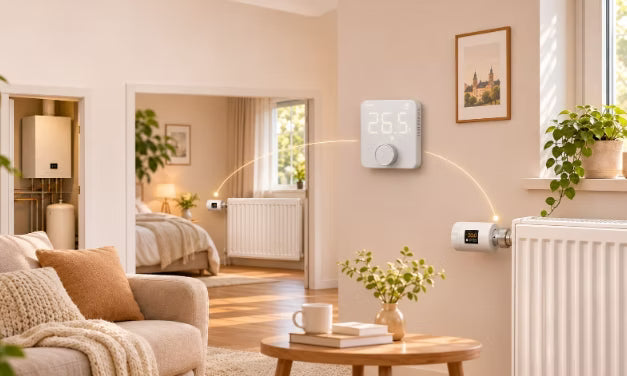
The SONOFF Thermostat Core TP-WGZBA is a Zigbee smart thermostat designed for compatible boiler and hydronic underfloor heating systems. It combines central heating control with flexible schedules, external temperature sensing, and smart-home integration.
System compatibility: TP-WGZBA requires a 100–240V AC live and neutral supply. It provides voltage-free COM/NO dry-contact control for compatible boilers and a separate powered AC output (max. 3A resistive load) for suitable hydronic heating actuators. It does not support OpenTherm or direct control of electric underfloor heating.
Key Features:
- Flexible Heating Schedules: Support three switchable weekly plans, each with up to 12 temperature periods per day. Saved schedules continue locally during temporary Zigbee disconnections while the thermostat remains powered.
- External Temperature Sensing: Use a compatible sensor, such as the SNZB-02D, SNZB-02LD, or SNZB-02WD, to control heating based on a more representative room temperature. For eWeLink integration, the sensor and thermostat must connect through the same compatible SONOFF Zigbee gateway. 👉 Home Assistant users can also configure an external temperature source with a blueprint.
- APP Heating Control and Automation: Adjust temperatures remotely, manage heating schedules, and create smart scenes through the eWeLink App. Open-window detection can also pause heating when a rapid temperature drop or a compatible door/window sensor indicates an open window.
- Smart Home Integration: Works with compatible SONOFF Zigbee gateways and selected third-party platforms, including Home Assistant via Zigbee2MQTT or ZHA. Available features depend on the gateway and integration method. 👉See the Compatible Zigbee Hubs List and feature comparison list before setup.
- Adjustable Temperature Hysteresis: Set separate start and stop thresholds within −2.6°C to +2.6°C relative to the target temperature. This helps manage temperature fluctuations and reduce frequent heating on/off cycles.
SONOFF Smart TRVs for Individual Radiator Control
For homes with hot-water radiators, both the SONOFF TRVZB and TRV-ZBT Gen2 provide individual radiator temperature control without changing the main thermostat's role.
Both models support adaptive valve control(PID), heating schedules, remote temperature adjustments, and open-window detection.
- TRVZB: Offers one weekly heating schedule with up to six periods per day.
- TRV-ZBT Gen2: Offers three switchable weekly plans with up to 12 periods per day, plus a compact design, rotatable IPS color display, sensor-based window detection through a compatible gateway, and a low-noise valve mechanism.
TP-WGZBA and TRV-ZBT Gen2: Coordinated Heating Control
Through a compatible SONOFF Zigbee gateway, TP-WGZBA can coordinate with TRV-ZBT Gen2 using Thermostat Panel Control in eWeLink. The original TRVZB does not currently support this integration.
- Synchronized Settings: Manage target temperatures, operating modes, and heating schedules across linked TRV-ZBT valves from the thermostat panel.
- Shared Temperature Readings: TRV-ZBT can use the TP-WGZBA's built-in sensor as an external temperature reference when both devices are in the same heating area.
Note: Compatible gateways and firmware are required. Synchronizing settings does not automatically provide independent boiler heat-demand control for each room.

Conclusion
Improving central heating control doesn't always require a new thermostat. A better placement, suitable temperature settings, and a heating schedule may be enough to make your existing system more comfortable to use.
For homes with hot-water radiators, TRVs offer additional control in individual rooms. If you need remote adjustments or coordinated heating settings, smart controls can provide more flexibility, provided they are compatible with your heating system.
FAQ
Q1: Do I need a thermostat in every room?
No. Many central heating systems use one main thermostat for a heating zone, with TRVs controlling individual radiators. Separate room thermostats may be needed if you want independently controlled heating zones.
Q2: Can smart TRVs work with a central heating thermostat?
Yes. Smart TRVs can adjust individual radiator temperatures while the main thermostat controls heating demand. However, independent room-by-room heating requires compatible controls that can pass each room's heating demand to the heat source.
Q3: Can I use a smart thermostat with an older central heating system?
Possibly. Compatibility depends on the system's control interface, wiring, and power requirements, not just its age. Check these before replacing your existing thermostat.
Q4: Will a smart central heating thermostat reduce my heating bills?
Not necessarily. Smart controls can help avoid unnecessary heating through schedules and more flexible temperature adjustments, but actual savings depend on your heating system, insulation, and how you use it.

Hinterlasse einen Kommentar
Alle Kommentare werden vor der Veröffentlichung geprüft.
Diese Website ist durch hCaptcha geschützt und es gelten die allgemeinen Geschäftsbedingungen und Datenschutzbestimmungen von hCaptcha.